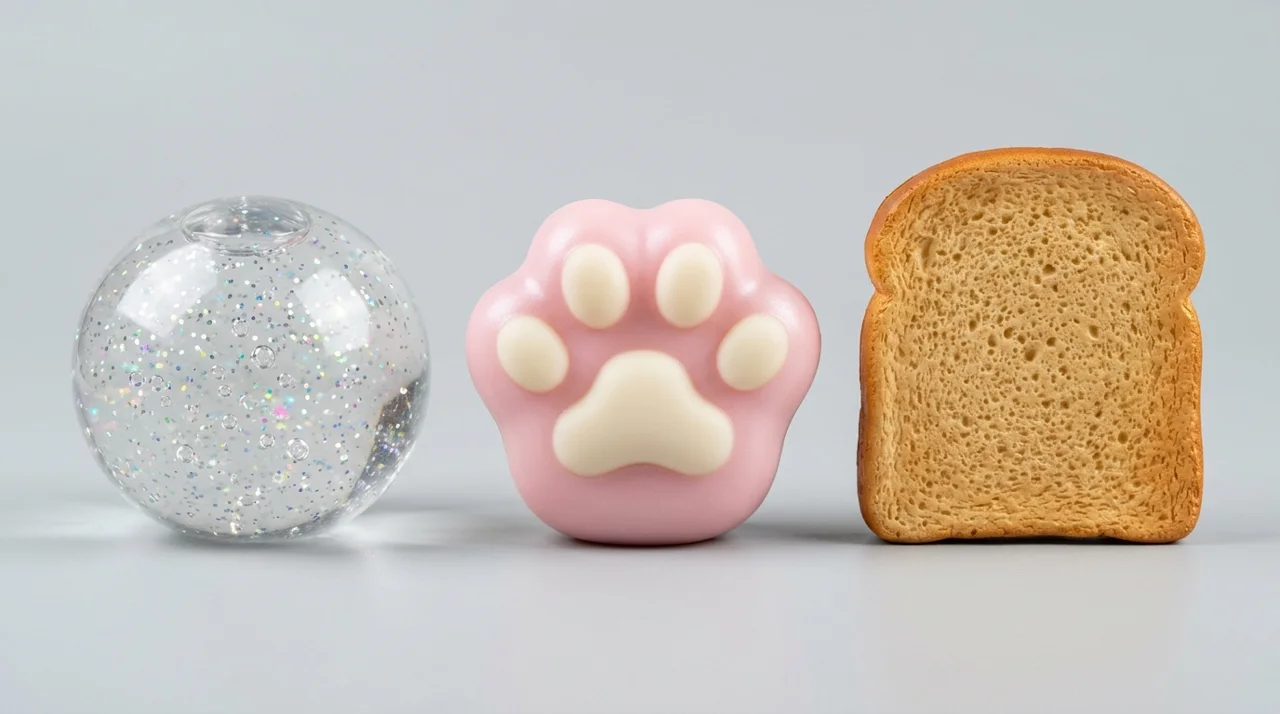
A plain-English squishy toy materials comparison from our Jinhua factory floor — pitting food-grade silicone, crunchy TPR, slow-rising PU foam, and maltose gel on durability, rebound, safety, and MOQ.
In a real squishy toy materials comparison, crunchy TPR (144 pcs/ctn) wins for low-MOQ testing and ASMR crunch, food-grade silicone wins for Taba squishy durability and creamy slow rebound, PU foam squishies win for lightweight classic slow-rise promotional shapes, and bead-free maltose gel wins for silent fidget stress relief.
Here's something most wholesale catalogs won't tell you: when a batch of squishy toys gets hit with 1-star reviews or customs holds, it's almost never because you picked the wrong animal shapes. It's because you picked the wrong squishy material for your buyer.
Order cheap tin-cure silicone and your warehouse smells like vinegar. Order thin-wall foam squishies and that foam squishy tears in a week. Order unverified gel balls and squishies can burst right inside an Amazon FBA shipping carton.
So let's do an honest, factory-floor squishy comparison. Below is how all five materials for squishy toys actually behave when you compress a squishy toy 500 times, ship your squishies across the ocean, and put every fidget toy through testing for safety in the US and Europe.
Quick Squishy Toy Materials Comparison: Food-Grade Silicone vs. TPR vs. Foam
If you want the short version before diving into each squishy material, here's how our five core materials stack up on tactile feel, rebound, durability, toy safety, and wholesale MOQ:
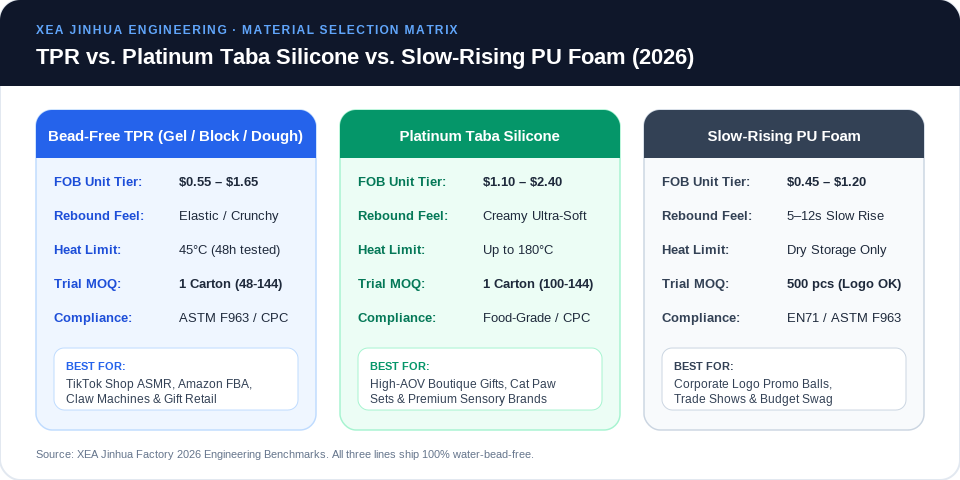
| Squishy Material | Squeeze Feel & Rebound | Durability & Washability | Stock / OEM MOQ | Quality & Safety Profile |
|---|---|---|---|---|
| Crunchy Building Block TPR | Crisp ASMR crunch, bouncy tactile snap | Thick TPR skin; wipe clean | 144 pcs (1 Ctn) / 500 OEM | 100% bead-free, BPA-free, ASTM F963-23 & EN71 |
| Food-Grade Silicone (Taba) | Creamy, dense, 6-8s slow rebound | More durable than foam; washable | 500 pcs / 3,000 Custom Mold | Non-toxic platinum silicone; zero harsh odor |
| Slow-Rising PU Foam | Classic slow-rise memory foam (8-15s) | Lightweight PU foam; surface paint can crease | 500 pcs (Logo) / 3,000 Mold | Phthalate-free polyurethane foam; optional safe scent |
| Maltose / Sugar Gel Core | Heavy, firmer stress-ball type feel | Leak-tested thick shell; silent knead | 500 pcs / 1,000 Custom Box | Zero expandable water beads; CPSIA & CPC ready |
| Mini Mochi TPR | Soft pocket pinch (12-25g soft toy) | Washable with mild soap; single OPP | 1,000+ pcs / Pack Assortments | Age 3+ small-parts labeled; EN71 & ASTM |
Food-Grade Silicone vs. TPR: Which Squishy Material Actually Lasts Longer?
Food-grade silicone wins hands-down on durability and luxury hand feel, while TPR wins on unit price, ASMR crunch, and low-MOQ testing. If your customers are paying $12 to $22 for a boutique taba squishy, solid platinum silicone squishies tend to last longer than any regular squishy because they're cast from one cohesive, tear-resistant elastomer—there's no thin outer skin waiting to split.
Why Food-Grade Silicone Beats Cheap Knockoffs
When buyers ask if food-grade silicone is the best material used in modern silicone squishy toys, the honest answer is yes, provided your supplier actually pours platinum-cure silicone (similar in softness to EcoFlex 00-30 silicone grades) instead of cheap industrial tin-cure silicone. Tin-cure silicone bleeds oil, yellows fast, and smells terrible. Platinum food-grade silicone is non-toxic, BPA-free, odorless, and washable, making it popular for stress relief and high-margin gift retail.
TPR, on the other hand, is a thermoplastic rubber that lets factories build hollow shells stuffed with solid bead-free crunchy mini-blocks or dense maltose fillings, creating a dumpling squishy or crunchy block fidget toy at a fraction of silicone's unit cost.
Compare our stocked Crunchy Building Block TPR line with our Taba & Platinum Silicone Squishies to see exact MOQ differences.
Slow-Rise PU Foam Squishies: When Classic Memory Foam Still Wins
Choose slow-rising foam (specifically flexible polyurethane foam) when you need lightweight jumbo collectibles, butter squishy bakery loaves, or crisp corporate logo stress toys. Unlike memory foam cut from pillows, toy-grade PU foam is molded in closed cavities, factories don't just mix polyurethane with soft foam scraps; they cure an integral flexible skin so each foam squishy delivers that classic slow-rise feel, taking 8 to 15 seconds to rebound after you squish it flat.
Because PU foam weighs only 35g to 90g per squishy toy, air freight stays cheap. That's why promotional agencies and bookstores still love foam squishies for sensory and fidget impulse racks. The trade-off? Solid silicone is more durable than foam under aggressive pinching, so PU foam quality depends heavily on proper oven curing and flexible topcoat paint.
Inspect slow-rising options on our Slow-Rising PU Foam & Stress Balls page.
Dumpling Squishy, Maltose Gel & Fidget Toy Feel: Avoiding Burst Risks
Choose maltose gel or soft dough cores when your buyers want a firmer, silent stress-ball stressball type feel for adult desks, classrooms, or sensory fidget therapy, and stay 100% away from expandable water beads.
Here's the real reason squishies can burst in retail: cheap factories pair paper-thin TPR skins with water-bead gel that swells and pops seams during shipping. At XEA Jinhua, every dumpling squishy (whether mini steamer dumpling or jumbo dumpling), ice cube, and fidget toy SKU uses heavy-wall TPR sealed around non-toxic, 100% water-bead-free maltose or dough cores. You get that heavy, satisfying stress relief knead without triggering US CPSC recalls or Amazon CPC suspensions.
Quality and Safety: How to Prove Squishy Toys Are Safe Before Shipping
Every single squishy (whether foam and gel or silicone and foam) must prove it doesn't contain harmful chemicals before clearing US or European customs. Don't rely on vague verbal promises that "our squishy toys are safe." Ask your factory for three concrete quality and safety checkpoints:
- US Compliance (ASTM F963-23 & CPSIA / CPC): Verifies lead limits (<100 ppm), phthalate-free plasticizers (<0.1%), and mechanical seam pull tests.
- EU & UK Compliance (EN71 Parts 1-3 & CE): Confirms flammability, physical tension, and heavy-metal migration limits on painted faces.
- AQL 2.5 Pre-Shipment Inspection: Checks wall thickness, rebound consistency, dust-free OPP sealing, and 5-ply master carton weights (16-28 kg) before your balance payment leaves the bank.
See how our Jinhua lab screens raw resins and runs pull checks on our Factory & Quality Control page, or send your target channel on our Contact & 24h RFQ page for a mixed 5-material sample kit.
Frequently Asked Questions
What's inside kids' squishy toys, and are they non-toxic?
 Quality wholesale squishies are made from one of five non-toxic, BPA-free materials: solid platinum silicone, slow-rising polyurethane foam, thick TPR filled with solid bead-free crunchy blocks, high-viscosity maltose gel, or soft mini mochi TPR. Always avoid expandable water beads to stay ASTM F963-23 and CPSC compliant.
Which squishy material is the most durable for heavy daily squeezing?
Solid-cast food-grade platinum silicone (used in authentic Taba squishies) is more durable than PU foam because it has no hollow seam to burst and washes clean with mild soap and water. Heavy-wall Crunchy Block TPR is a close second for ASMR play.
Why do some squishies rise slowly while others bounce right back?
Rebound speed depends on cell structure and viscosity. Open-cell polyurethane foam traps and releases air slowly for an 8-15 second slow-rise, platinum silicone rebounds in a creamy 6-8 seconds, and hollow TPR shells snap back faster around their inner crunchy or gel core.
Can I order a mixed sample box comparing TPR, silicone, and PU foam?
Yes. Our Jinhua factory ships mixed 5-material evaluation kits via DHL or UPS in 3-5 business days so your team can compare rebound, tactile crunch, and durability before placing a bulk order.